
Choosing a CNC machining services provider is one of the most important decisions an engineering or procurement team can make. Whether you’re sourcing precision components for aerospace, robotics, medical devices, industrial automation, electronics, or general engineering, the right CNC machining manufacturer can significantly influence product quality, project timelines, and overall manufacturing costs.
Many companies focus primarily on obtaining the lowest quotation. While competitive pricing is important, the true cost of manufacturing extends far beyond the unit price. Poor quality, delayed deliveries, inconsistent tolerances, engineering errors, and inadequate communication often lead to higher costs over the lifecycle of a project.
A reliable machining vendor does more than manufacture parts—they become an extension of your engineering and supply chain teams. They contribute to design optimization, improve manufacturability, maintain consistent quality, and support your production goals from prototype through high-volume manufacturing.
This guide explores the key factors to consider when selecting CNC machining services, helping you make informed sourcing decisions and build long-term manufacturing partnerships.
What Are CNC Machining Services?
CNC machining services encompass a range of manufacturing processes where computer-controlled machine tools remove material from raw stock to produce precision-engineered components. These services are widely used to manufacture parts requiring tight tolerances, complex geometries, excellent surface finishes, and repeatable quality. Unlike conventional machining, where machine movements depend on manual operation, CNC machining uses digital programs (G-code) to control every cutting move ment with exceptional accuracy.
Modern CNC machining manufacturers offer far more than simple milling or turning operations. Comprehensive machining services often include:
- CNC Milling
- CNC Turning
- Multi-axis machining (3-axis, 4-axis, and 5-axis)
- Drilling and tapping
- Precision boring and reaming
- Surface finishing
- Heat treatment coordination
- Assembly services
- Quality inspection
- Prototype development
- Production machining
Typical CNC Machining Workflow
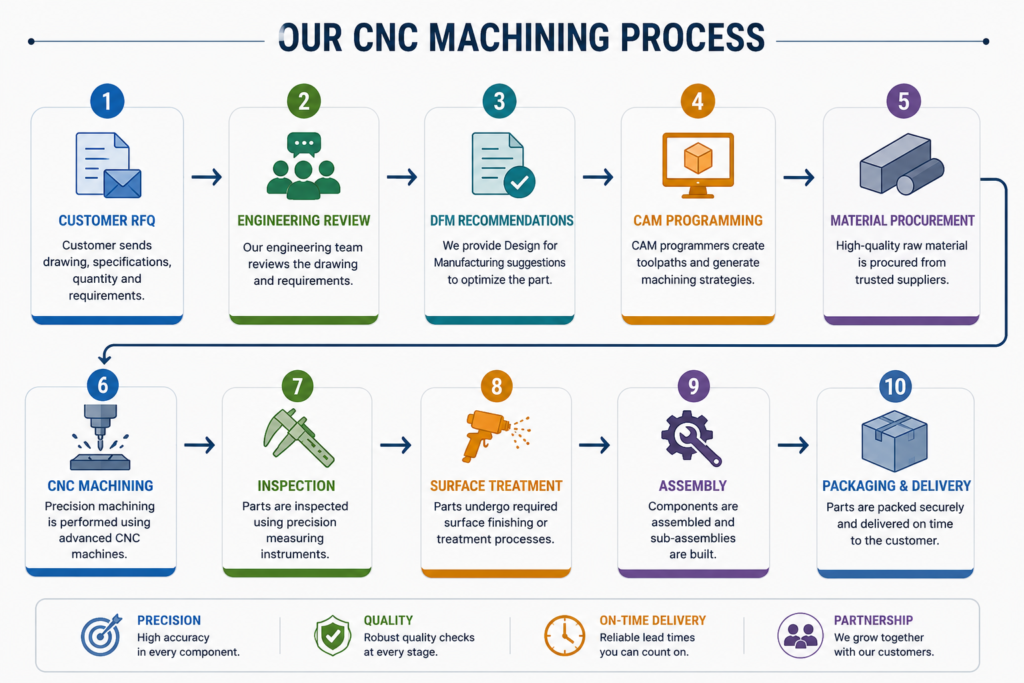
The best CNC machining services integrate engineering expertise, quality assurance, and project management into every stage of this workflow.
Why Choosing the Right CNC Machining Manufacturer Matters
Selecting the right CNC machining manufacturer is not simply about finding a supplier with available machines. It is about partnering with a company that consistently delivers precision, reliability, and technical expertise.
An experienced machining partner can:
- Improve product quality
- Reduce manufacturing costs
- Shorten lead times
- Minimize production risks
- Enhance design for manufacturability (DFM)
- Ensure consistent quality across production batches
Conversely, selecting an inexperienced machining vendor may result in:
sely, selecting an inexperienced machining vendor may result in:
| Poor Supplier | Business Impact |
| Inconsistent tolerances | Assembly failures |
| Poor surface finish | Additional rework |
| Limited machine capability | Outsourced operations and delays |
| Weak quality systems | Higher rejection rates |
| Poor communication | Missed deadlines |
| Inadequate engineering support | Increased production costs |
In today’s competitive manufacturing landscape, businesses increasingly seek precision engineering partners capable of delivering both technical excellence and dependable supply chain performance.
Understand Your Manufacturing Requirements Before Requesting a Quote
Before contacting machining manufacturers, it is essential to define your project requirements clearly. Well-prepared RFQs reduce misunderstandings, improve quotation accuracy, and shorten project lead times.
A comprehensive RFQ should include:
| Requirement | Example |
| Part Drawing | PDF + STEP File |
| Material | Aluminium 6061-T6 |
| Quantity | 1,000 Pieces |
| Surface Finish | Hard Anodizing |
| Tolerance | ±0.02 mm |
| Inspection Requirement | First Article Inspection (FAI) |
| Delivery Schedule | Monthly Releases |
| Revision Level | Rev D |
Providing complete technical information allows the CNC machining manufacturer to evaluate the project accurately and recommend cost-effective manufacturing strategies.
Prototype Machining vs Production Machining
Not every supplier excels at both prototype development and production manufacturing.
Prototype machining focuses on speed and engineering flexibility, while CNC production machining emphasizes process optimization, repeatability, and cost efficiency.
| Prototype Machining | CNC Production Machining |
| Low quantities | High-volume production |
| Fast engineering changes | Stable production processes |
| Higher unit cost | Lower unit cost |
| Rapid delivery | Long-term scheduling |
| Development focus | Manufacturing efficiency |
If your product is expected to scale, choose a supplier capable of supporting the entire product lifecycle—from prototypes to full production.
Engineering Support Is More Valuable Than Most Buyers Realize
The best CNC machining services begin long before the first chip is cut.
Experienced engineering teams review customer drawings to identify opportunities for:
- Reducing machining time
- Simplifying complex geometries
- Improving tool accessibility
- Optimizing material usage
- Reducing manufacturing costs
- Improving assembly performance
These Design for Manufacturing (DFM) recommendations can significantly reduce overall project costs without affecting functionality.
For example, replacing unnecessarily tight tolerances or redesigning inaccessible pockets may reduce machining time by 20–40%, directly lowering production costs.
A supplier with strong engineering capabilities becomes a technical partner rather than simply a component manufacturer.
Manufacturing Capability: Can They Machine What You Need?
One of the first questions buyers should ask is whether the supplier has experience manufacturing similar components.
Different industries require different expertise.
A company specializing in automotive brackets may not possess the capabilities required for aerospace-grade precision components.
Look for experience with:
- Aerospace components
- Robotics assemblies
- Semiconductor equipment
- Medical devices
- Industrial automation
- Precision instruments
- Defense applications
Similarly, verify material expertise.
A capable CNC machining manufacturer should routinely machine:
- Aluminum alloys
- Stainless steel
- Carbon steel
- Tool steel
- Titanium
- Brass
- Copper
- Engineering plastics
- High-performance polymers
Material knowledge plays a major role in achieving dimensional accuracy, surface finish, and tool life.
15 Factors to Consider When Choosing the Right CNC Machining Partner
Selecting a CNC machining services provider should never be based solely on price. The best CNC machining manufacturers combine advanced machining capabilities, engineering expertise, quality systems, and reliable delivery performance to become long-term manufacturing partners.
Whether you’re sourcing precision prototypes or high-volume production components, evaluating the following factors will help you identify a machining partner capable of meeting your technical and commercial expectations.
1. Manufacturing Capability
The first step is determining whether the supplier has the capability to manufacture your components—not just today, but as your project grows.
A reputable CNC machining manufacturer should have experience machining a broad range of materials and component sizes while supporting both low-volume and production machining.
Ask questions such as:
- What industries do you currently serve?
- What is the largest component you machine?
- What is the smallest feature you can produce?
- Can you manufacture both prototype and production quantities?
- Do you offer assembly and secondary operations?
Suppliers with diverse manufacturing capabilities are generally better equipped to support engineering changes and future product expansions.
Manufacturing Capability Checklist
| Capability | Importance |
| CNC Milling | ★★★★★ |
| CNC Turning | ★★★★★ |
| Multi-axis Machining | ★★★★★ |
| Sheet Metal Fabrication | ★★★★☆ |
| Plastic Machining | ★★★★☆ |
| Assembly | ★★★★★ |
| Surface Finishing | ★★★★★ |
| Prototype Manufacturing | ★★★★★ |
| Production Machining | ★★★★★ |
A supplier offering integrated manufacturing services reduces vendor management, shortens lead times, and simplifies project coordination.
2. Machine Capacity and Technology
Not every component requires a 5-axis machine, but every component deserves to be machined on equipment that is suited to its geometry and tolerance requirements.
An experienced CNC machining services provider invests in a range of machine tools to handle different manufacturing challenges efficiently.
Typical CNC Machine Types
| Machine Type | Best For |
| 3-Axis VMC | General prismatic components |
| 4-Axis CNC | Indexed machining and multiple side operations |
| 5-Axis CNC | Complex aerospace and medical components |
| CNC Turning Center | Shafts, bushes, pins, and rotational parts |
| Turn-Mill Center | Combined milling and turning operations |
| Swiss-Type CNC | Small, high-precision components |
Choosing the right machine improves:
- Surface finish
- Positional accuracy
- Cycle time
- Repeatability
- Overall manufacturing cost
A supplier with multiple machine configurations can optimize production rather than forcing every part onto a limited set of equipment.
3. Engineering Support & Design for Manufacturability (DFM)
The best machining partners don’t simply manufacture what is drawn—they help improve it.
An experienced engineering team reviews drawings before production to identify opportunities for:
- Reducing machining complexity
- Eliminating unnecessary tolerances
- Improving tool accessibility
- Simplifying setups
- Optimizing material usage
- Lowering production costs
For example, redesigning a deep internal pocket or increasing a non-critical corner radius may reduce machining time by 30% without affecting product functionality.
These Design for Manufacturability (DFM) improvements often deliver significant savings over the life of a project.
4. Quality Management System
Quality should never rely solely on operator experience.
A professional CNC machining manufacturer follows documented quality procedures supported by internationally recognized certifications.
Look for suppliers certified to standards such as:
| Certification | Industry |
| ISO 9001 | General Manufacturing |
| AS9100 | Aerospace |
| ISO 13485 | Medical Devices |
| IATF 16949 | Automotive |
Equally important is understanding how quality is managed on the shop floor.
Questions to ask include:
- Are inspections performed during machining?
- Is every batch inspected before shipment?
- Are inspection reports available?
- Is process capability monitored?
- How are non-conformances handled?
A mature quality system reduces variability and builds confidence in long-term production.
5. Inspection Equipment and Metrology
Precision machining requires precision measurement.
Even the most advanced CNC machine cannot guarantee quality without accurate inspection equipment.
A capable machining partner should have access to modern metrology equipment such as:
- Coordinate Measuring Machines (CMM)
- Vision Measurement Systems
- Height Gauges
- Bore Gauges
- Surface Roughness Testers
- Thread Gauges
- Digital Micrometers
- Digital Vernier Calipers
Inspection Process
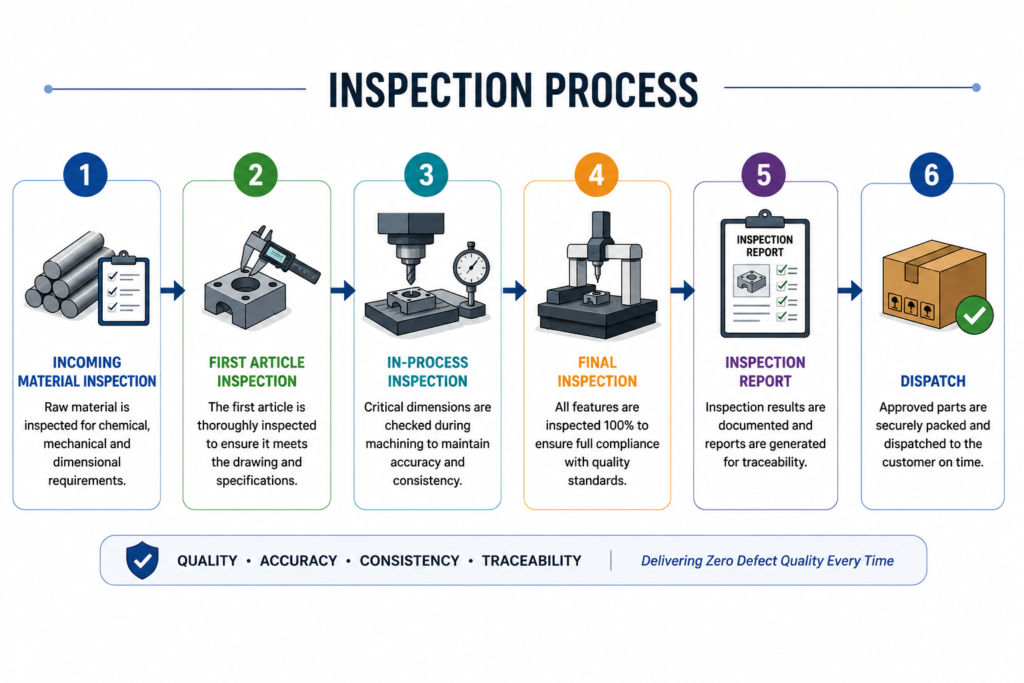
This layered inspection approach minimizes defects before they reach the customer.
6. Tolerance Capability
Many suppliers advertise tight tolerances, but maintaining them consistently across production is far more challenging than achieving them on a single prototype.
Ask your supplier:
- What is your standard machining tolerance?
- What is the tightest tolerance you can repeatedly maintain?
- How do you verify critical dimensions?
- Do you perform Statistical Process Control (SPC)?
Typical CNC Machining Capability
| Feature | Typical Capability |
| General Dimensions | ±0.05 mm |
| Precision Components | ±0.02 mm |
| High-Precision Features | ±0.005–0.010 mm |
Keep in mind that tighter tolerances increase machining time, tooling costs, inspection effort, and overall manufacturing cost. An experienced machining partner will recommend tighter tolerances only where they are functionally necessary.
7. Material Expertise
Material selection directly influences machining strategy, tool life, cycle time, and final part performance.
An experienced CNC machining services provider should routinely machine:
- Aluminium alloys
- Stainless steels
- Carbon steels
- Tool steels
- Titanium alloys
- Brass
- Copper
- PEEK
- Delrin
- Nylon
- PTFE
- Engineering plastics
Just as importantly, they should understand the unique challenges associated with each material, such as heat generation, work hardening, chip control, and dimensional stability.
Material expertise helps avoid machining defects and ensures consistent component performance.
8. Supply Chain Integration
Modern manufacturing rarely ends with machining alone.
Most precision components require secondary operations before delivery, including:
- Heat Treatment
- Hard Anodizing
- Black Anodizing
- Zinc Plating
- Nickel Plating
- Powder Coating
- Passivation
- Laser Marking
- Silk Screening
- Assembly
A machining manufacturer capable of managing these processes under one project team simplifies communication and reduces lead times.
Instead of coordinating multiple vendors, customers benefit from a single point of responsibility.
9. Production Capacity and Scalability
Your first order may consist of only 20 parts, but future demand could increase to 20,000.
Can your supplier grow with you?
Evaluate whether the manufacturer can support:
- Prototype quantities
- Low-volume production
- Medium-volume production
- High-volume manufacturing
- Long-term production programs
A scalable supplier minimizes the need to requalify new vendors as your business expands.
10. Delivery Performance
Late deliveries disrupt production schedules, delay product launches, and increase inventory costs.
Ask potential suppliers for measurable performance indicators such as:
- On-Time Delivery (OTD)
- Average Lead Time
- Production Capacity Utilization
- Expedited Order Capability
- Supplier Performance History
Reliable delivery performance is often a better indicator of operational excellence than price alone.
11. Communication and Project Management
Strong communication is one of the most underrated characteristics of a successful manufacturing partner.
During production, customers should receive:
- Prompt quotation responses
- Technical clarifications
- Engineering recommendations
- Weekly production updates
- Delivery notifications
- Immediate communication regarding any production issues
Transparent communication builds trust and prevents costly misunderstandings.
12. Pricing: Look Beyond the Lowest Quote
Many buyers focus exclusively on the lowest unit price. However, the cheapest supplier can quickly become the most expensive if poor quality or missed deadlines lead to rework, production stoppages, or warranty claims.
Lowest Price vs. Lowest Total Cost
| Lowest Quote | Best Manufacturing Partner |
| Lower piece price | Lower total cost of ownership |
| Higher rejection rates | Consistent quality |
| Limited engineering support | DFM recommendations |
| Frequent delays | Reliable on-time delivery |
| Hidden costs | Predictable manufacturing costs |
When evaluating CNC machining services, consider the total value delivered—not just the initial quotation.
13. Technology & Digital Manufacturing: Why Modern CNC Shops Have the Edge
Precision machining is no longer driven solely by skilled operators and advanced CNC machines. Today, leading CNC machining manufacturers are embracing digital technologies to improve efficiency, consistency, and traceability across the manufacturing process.
A digitally enabled manufacturing environment helps reduce human error, optimize machine utilization, and provide customers with greater transparency throughout production.
Features of a Modern CNC Machining Facility
| Technology | Customer Benefit |
| ERP System | Real-time production planning and scheduling |
| CAM Software | Optimized machining strategies and shorter cycle times |
| Digital Job Tracking | Improved traceability and production visibility |
| Tool Management Systems | Longer tool life and consistent machining quality |
| Preventive Maintenance | Higher machine uptime and reliable delivery |
| Barcode/QR Traceability | Easy tracking of components and batches |
| Digital Quality Records | Faster documentation and audit readiness |
Modern manufacturing is no longer just about cutting metal—it is about managing information efficiently. Suppliers who invest in technology are often better equipped to meet demanding production schedules while maintaining consistent quality.
14. Questions Every Buyer Should Ask Before Finalizing a CNC Machining Partner
A supplier may have an impressive website and a competitive quotation, but the real test lies in the questions you ask during the evaluation process.
Here are some of the most important questions procurement teams and engineers should ask before awarding a project.
Engineering Capability
- Can you review our design for manufacturability (DFM)?
- Can you recommend cost-saving design improvements?
- Have you manufactured similar components before?
Manufacturing Capability
- What CNC machines do you operate?
- Can you machine aluminium, stainless steel, titanium, brass, and engineering plastics?
- What are your maximum machining capacities?
Quality Assurance
- What certifications do you hold?
- Do you perform First Article Inspection (FAI)?
- Can you provide CMM inspection reports?
- How do you control dimensional consistency during production?
Production Support
- Can you scale from prototypes to mass production?
- What is your average lead time?
- How do you manage engineering revisions?
- Do you provide assembly and secondary operations?
Commercial
- What are your payment terms?
- What is your on-time delivery performance?
- Can you support annual demand fluctuations?
The answers to these questions reveal far more about a supplier than a quotation ever will.
15. Common Mistakes Buyers Make When Choosing CNC Machining Services
Even experienced procurement teams occasionally make decisions that lead to unnecessary costs or project delays.
Avoid these common mistakes when evaluating CNC machining services.
Choosing Based Only on Price
The lowest quotation rarely represents the lowest total manufacturing cost.
Cheap suppliers often compensate by using lower-quality tooling, insufficient inspection, or outdated equipment, leading to higher rejection rates and increased rework.
Ignoring Engineering Expertise
Some suppliers simply manufacture according to the drawing without questioning whether the design can be improved.
A strong engineering team can reduce machining time, improve manufacturability, and lower overall production costs.
Overlooking Quality Systems
Without documented quality procedures, consistency becomes dependent on individual operators.
Certified quality systems ensure repeatability across every production batch.
Not Evaluating Production Capacity
A supplier may produce excellent prototypes but struggle when demand increases.
Always verify machine capacity, workforce availability, and long-term production capability.
Poor RFQ Documentation
Incomplete drawings, missing material specifications, or unclear tolerances often result in inaccurate quotations and unexpected engineering changes.
The more complete your RFQ, the more accurate the manufacturing plan will be.
Red Flags That Indicate an Unreliable CNC Machining Supplier
Before awarding a purchase order, look out for warning signs that may indicate operational weaknesses.
🚩 Supplier Red Flags
❌ Extremely low quotations compared to competitors
❌ No engineering support
❌ No ISO-certified quality system
❌ Unable to provide inspection reports
❌ Limited machine capability
❌ Poor communication during quotation stage
❌ Unrealistically short lead times
❌ No customer references or case studies
❌ Frequent changes to quotations
❌ No documented process control
If several of these warning signs are present, it may be worth reconsidering the partnership.
Why Global OEMs Are Increasingly Choosing CNC Machining Services from India
Over the past decade, India has become one of the world’s fastest-growing destinations for precision CNC machining services. Global OEMs across aerospace, robotics, industrial automation, medical devices, and electronics are increasingly partnering with Indian manufacturers—not just for cost advantages, but for engineering expertise, manufacturing quality, and supply chain reliability.
Several factors have contributed to this shift.
Engineering Talent
India produces a large pool of highly qualified mechanical and manufacturing engineers every year. This technical expertise enables manufacturers to support customers with Design for Manufacturability (DFM), process optimization, and complex machining challenges.
Competitive Manufacturing Costs
Lower operating costs allow Indian CNC machining manufacturers to deliver high-quality components at competitive prices without compromising on engineering standards or quality systems.
Advanced Manufacturing Infrastructure
Many leading Indian manufacturers have invested in modern CNC machining centers, automated inspection equipment, ERP systems, and digital production planning, enabling them to compete with global suppliers.
Strong Export Experience
Indian manufacturers routinely serve customers across North America, Europe, Australia, and Asia, with established processes for export documentation, international logistics, and customer support.
End-to-End Manufacturing
Many suppliers now offer integrated services, including CNC machining, metal fabrication, plastic injection molding, surface treatments, and mechanical assemblies, simplifying supply chain management for global customers.
For OEMs seeking dependable, scalable, and cost-effective manufacturing, India has become a strategic sourcing destination.CNC Machining Supplier Evaluation Scorecard
When comparing multiple suppliers, a structured evaluation can help you make objective decisions based on factors that matter most to your business.
| Evaluation Criteria | Weight (%) | Supplier A | Supplier B | Supplier C |
| Manufacturing Capability | 20 | |||
| Engineering Support | 15 | |||
| Quality Systems | 15 | |||
| Inspection & Metrology | 10 | |||
| Delivery Performance | 10 | |||
| Production Capacity | 10 | |||
| Cost Competitiveness | 10 | |||
| Communication | 5 | |||
| Certifications | 5 | |||
| Customer References | 5 | |||
| Total Score | 100 |
Using a scorecard encourages data-driven supplier selection rather than relying solely on price or intuition.
Final Thoughts
Selecting the right CNC machining services provider is about much more than comparing quotations. The right manufacturing partner combines precision engineering, modern machining capabilities, experienced engineers, robust quality systems, and dependable delivery performance to help you achieve long-term success.
Whether you’re developing a new product, scaling production, or optimizing your supply chain, choosing a capable CNC machining manufacturer can reduce manufacturing risks, improve product quality, shorten lead times, and lower the total cost of ownership.
A supplier that invests in engineering expertise, digital manufacturing, quality assurance, and continuous improvement will consistently deliver greater value than one competing on price alone. By evaluating manufacturing capability, inspection systems, scalability, communication, and production performance, you can build partnerships that support your business for years to come.
Why Choose HanaV for CNC Machining Services?
At HanaV, we understand that our customers are not just looking for machined components—they’re looking for a manufacturing partner they can rely on. With seven ISO 9001:2015 certified and AS9100:2016 certified manufacturing facilities in Bengaluru, India, we provide end-to-end CNC machining services, including precision CNC milling, CNC turning, sheet metal fabrication, plastic injection molding, and integrated electromechanical assemblies.
Our engineering team works closely with customers from the RFQ stage, offering Design for Manufacturability (DFM) recommendations that help reduce machining complexity, optimize material usage, and lower production costs without compromising performance. Backed by advanced machining centers, rigorous quality inspection, and a proven track record of 99.23% on-time delivery and 99.41% first-time-right quality, we support everything from rapid prototypes to high-volume production.
Whether you’re sourcing precision components for aerospace, robotics, industrial automation, medical devices, or general engineering applications, HanaV delivers the consistency, quality, technical expertise, and cost-effectiveness needed to keep your projects moving forward with confidence.