
Manufacturers today have access to numerous production methods, but two of the most widely used are CNC Machining and Sheet Metal Fabrication.
Both processes are capable of producing high-quality components for industries such as aerospace, robotics, medical devices, industrial automation, electronics, and defense. However, they differ significantly in terms of material usage, manufacturing approach, achievable geometries, production costs, and ideal applications.
One of the most common questions engineers ask during product development is:
Should this part be CNC machined or fabricated from sheet metal?
The answer depends on several factors including component design, material selection, tolerance requirements, production volume, assembly requirements, and cost objectives.
In this guide, we’ll compare both manufacturing methods in detail and help you determine which process is best suited for your application.
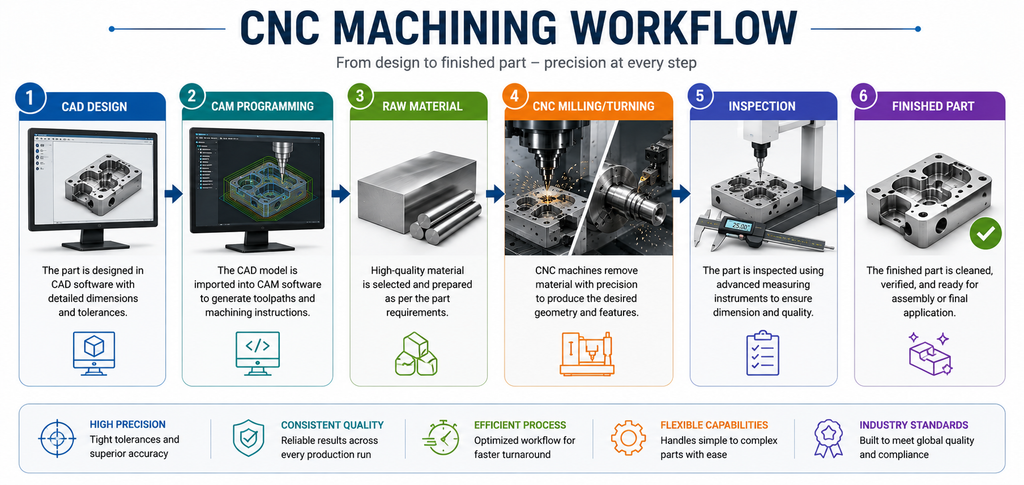
What is CNC Machining?
CNC Machining is a subtractive manufacturing process where material is removed from a solid block, plate, or bar using computer-controlled cutting tools.
Using technologies such as:
- CNC Milling
- CNC Turning
- 3-Axis Machining
- 4-Axis Machining
- 5-Axis Machining
manufacturers can produce highly precise components with complex geometries and tight tolerances.
Advantages of CNC Machining
- Tight tolerances
- Complex geometries
- High dimensional accuracy
- Excellent surface finish
- Suitable for metals and plastics
- Ideal for precision engineering applications
What is Sheet Metal Fabrication?
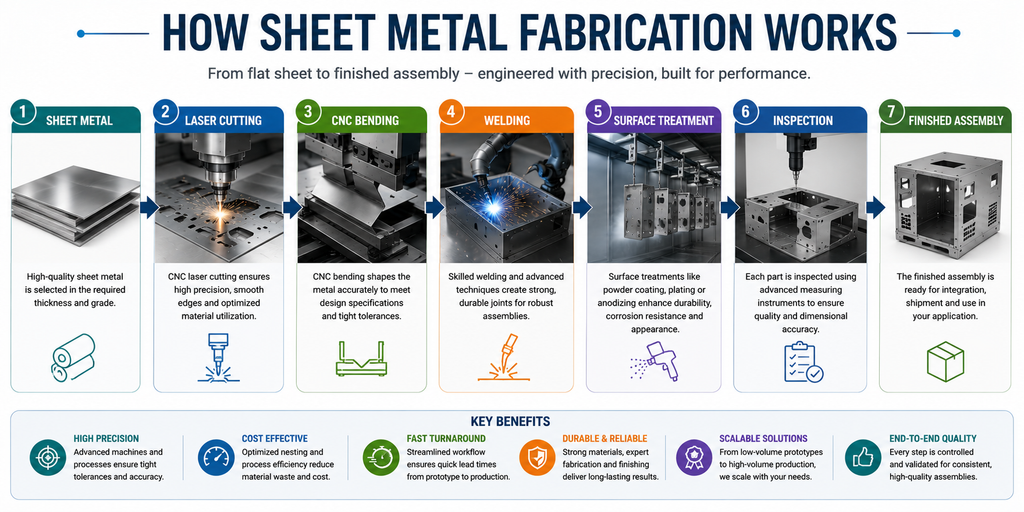
Sheet Metal Fabrication is a manufacturing process that transforms flat metal sheets into finished components through cutting, bending, forming, welding, and assembly operations.
Unlike CNC machining, which removes material from a solid block, sheet metal fabrication reshapes thin metal sheets into the required form.
Common fabrication processes include:
- Laser Cutting
- CNC Punching
- Bending
- Welding
- Riveting
- Fastening
- Powder Coating
- Assembly
Advantages of Sheet Metal Fabrication
- Lower material waste
- Faster production
- Cost-effective for large components
- Excellent for enclosures and brackets
- Lightweight structures
- Scalable production
CNC Machining vs Sheet Metal Fabrication: Key Differences
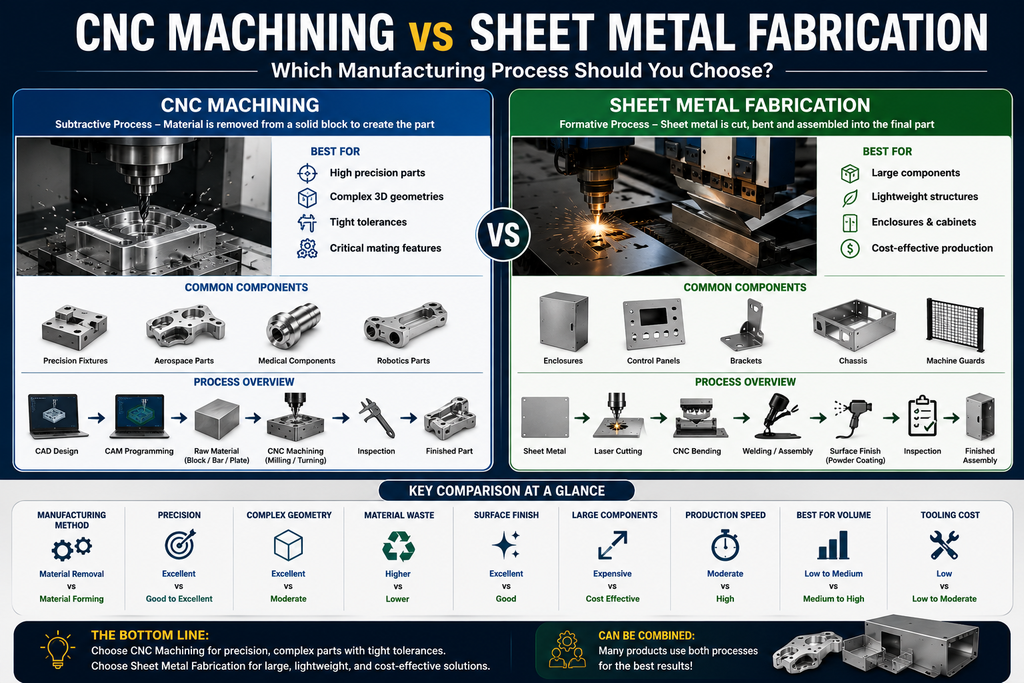
Comparison Table
| Factor | CNC Machining | Sheet Metal Fabrication |
| Manufacturing Method | Material Removal | Material Forming |
| Raw Material | Block, Plate, Bar | Metal Sheet |
| Precision | Excellent | Good to Excellent |
| Complex Geometry | Excellent | Moderate |
| Material Waste | Higher | Lower |
| Surface Finish | Excellent | Good |
| Large Components | Expensive | Cost Effective |
| Tooling Cost | Low | Low to Moderate |
| Production Speed | Moderate | High |
| Assembly Requirement | Lower | Higher |
Material Utilization and Waste
One of the biggest differences between the two processes is material utilization.
CNC Machining
A significant amount of material may be removed during machining.
Example:
Starting Material: 10 kg
Finished Component: 2 kg
Material Removed: 8 kg
This is common in aerospace and precision engineering applications.
Sheet Metal Fabrication
Material utilization is generally much higher.
Example:
Sheet Weight: 10 kg
Finished Component: 8–9 kg
Scrap Generated: 1–2 kg
For large structural components, fabrication is often considerably more economical.
Which Process Offers Better Precision?
When tolerances are critical, CNC Machining is usually the preferred solution.
Typical Tolerance Comparison
| Feature | CNC Machining | Sheet Metal Fabrication |
| General Tolerance | ±0.05 mm | ±0.25 mm |
| Precision Tolerance | ±0.01 mm | ±0.10 mm |
| Critical Features | Excellent | Limited |
| Complex Datum Control | Excellent | Moderate |
For aerospace, robotics, semiconductor and medical components, machining is often required to achieve precision requirements.
Cost Comparison
Cost is often the deciding factor.
However, cost depends heavily on component design.
CNC Machining Cost Drivers
- Machining time
- Material removal
- Tool wear
- Programming complexity
- Inspection requirements
Fabrication Cost Drivers
- Laser cutting time
- Bending operations
- Welding
- Surface finishing
- Assembly
Cost Comparison Table
| Component Type | Better Option |
| Precision Manifold | CNC Machining |
| Robot Bracket | Sheet Metal |
| Electronics Enclosure | Sheet Metal |
| Aerospace Housing | CNC Machining |
| Mounting Plate | Sheet Metal |
| Precision Fixture | CNC Machining |
Design Flexibility Comparison
CNC Machining Excels At
- Pockets
- Contours
- Curved surfaces
- Precision bores
- Threaded features
- Complex geometries
Examples
- Aerospace brackets
- Robot arms
- Medical housings
- Precision fixtures
Sheet Metal Fabrication Excels At
- Large panels
- Covers
- Chassis
- Cabinets
- Enclosures
- Welded structures
Examples
- Server racks
- Control panels
- Machine guards
- Electrical enclosures
- Equipment frames
Production Volume Considerations
| Volume | Preferred Process |
| Prototype | CNC Machining |
| Low Volume | Both |
| Medium Volume | Depends on Geometry |
| High Volume | Sheet Metal Fabrication |
For large production quantities, fabrication often becomes significantly more cost-effective.
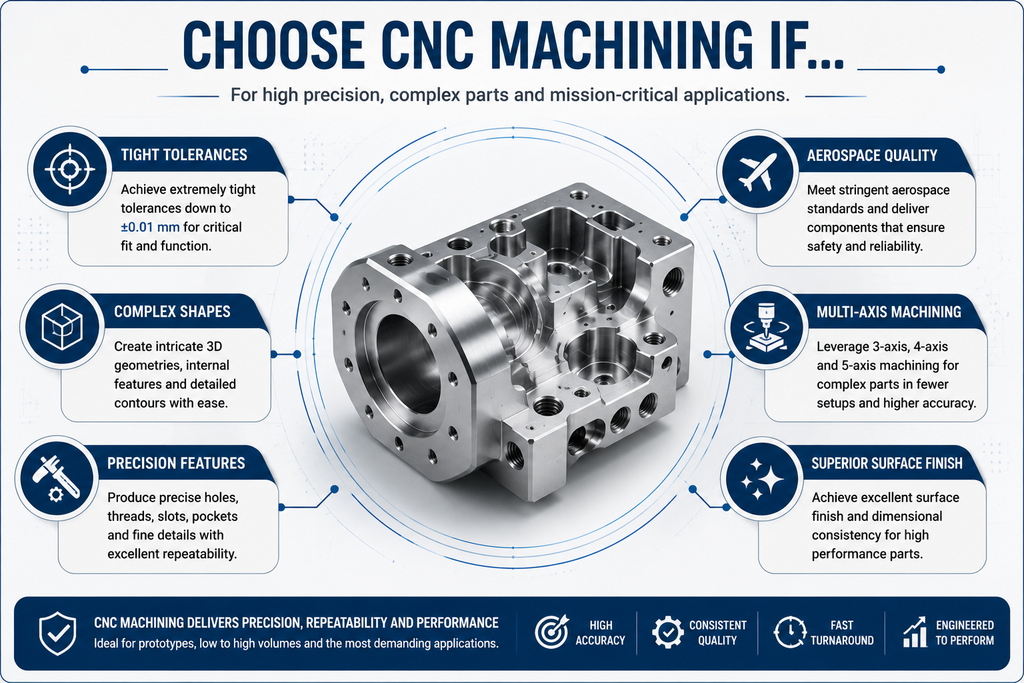
When Should You Choose CNC Machining?
Choose CNC Machining when your component requires:
- Tight tolerances
- Complex geometry
- High precision
- Critical mating features
- Precision bores
- Medical-grade accuracy
- Aerospace requirements
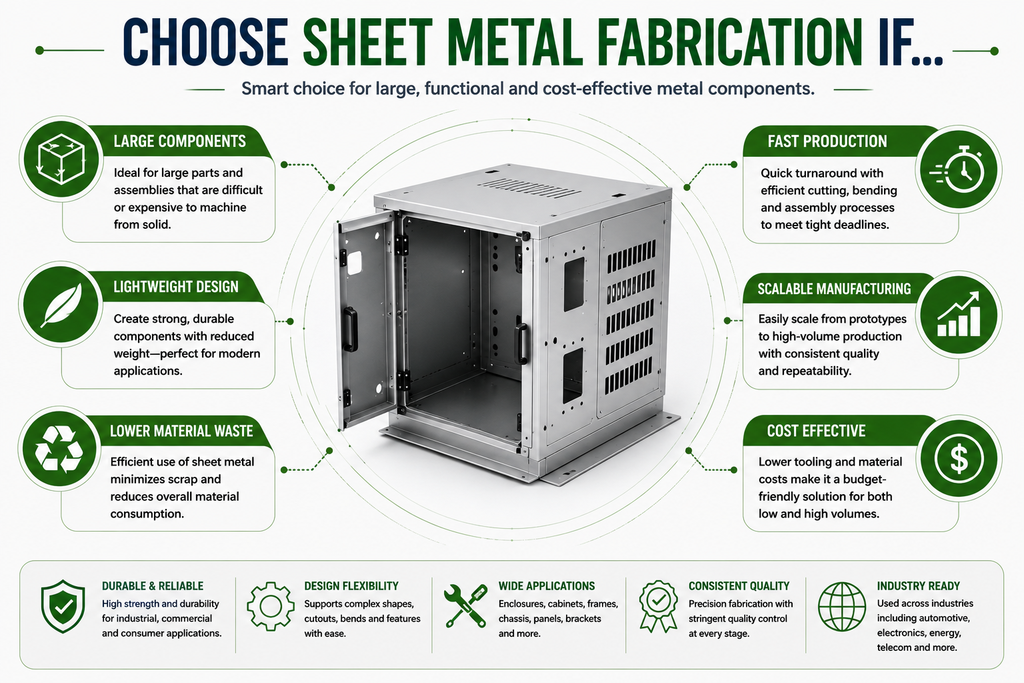
When Should You Choose Sheet Metal Fabrication?
Choose Sheet Metal Fabrication when your component requires:
- Large dimensions
- Lightweight construction
- Enclosures
- Structural assemblies
- Lower cost
- Faster production
Can CNC Machining and Sheet Metal Fabrication Be Combined?
Absolutely.
Many modern products use both manufacturing methods.
A typical industrial enclosure may contain:
- Fabricated outer housing
- CNC machined mounting plates
- Precision machined brackets
- Fabricated doors
- Machined heat sinks
- Welded assemblies
This is where integrated manufacturers provide the greatest value.
Industry Applications
| Industry | CNC Machining | Sheet Metal Fabrication |
| Aerospace | ✓ | ✓ |
| Robotics | ✓ | ✓ |
| Medical | ✓ | Limited |
| Electronics | ✓ | ✓ |
| Industrial Automation | ✓ | ✓ |
| Semiconductor | ✓ | Limited |
| Defense | ✓ | ✓ |
Final Thoughts
Neither process is universally better. The right choice depends on the component’s geometry, tolerance requirements, production volume, material, and overall cost objectives.
CNC Machining remains the preferred solution for precision-engineered parts requiring tight tolerances and complex geometries. Sheet Metal Fabrication excels when producing lightweight structures, enclosures, brackets, and large assemblies at lower cost.
For many products, the optimal manufacturing strategy combines both processes, leveraging the strengths of each to improve quality, reduce costs, and simplify assembly.
Why Choose HanaV?
At HanaV, we provide both Precision CNC Machining and Sheet Metal Fabrication under one roof, enabling customers to source complete assemblies from a single manufacturing partner. With seven ISO 9001:2015 & AS9100:2016 -certified manufacturing facilities, advanced CNC machining centers, laser cutting systems, CNC bending equipment, welding capabilities, and integrated assembly operations, we support everything from rapid prototypes to high-volume production. Our engineering team works closely with customers to recommend the most cost-effective manufacturing approach, ensuring the right balance of precision, quality, lead time, and overall cost. Backed by 99.23% on-time delivery and 99.41% first-time-right quality, HanaV helps global OEMs simplify their supply chains while maintaining consistent manufacturing excellence.