
In precision manufacturing, two machining processes dominate the production of high-quality metal and plastic components—CNC Milling and CNC Turning. While both fall under the umbrella of CNC machining, they operate differently and are suited to different types of parts.
For engineers, product designers, and procurement professionals, choosing between CNC milling and CNC turning is more than a technical decision. The right process can significantly reduce manufacturing costs, improve dimensional accuracy, shorten lead times, and simplify production. Selecting the wrong process, on the other hand, can increase machining time, material waste, and overall project costs.
So, how do you determine which process is right for your component?
The answer depends on several factors, including part geometry, material, tolerance requirements, production volume, and the complexity of the features being machined.
In this guide, we’ll compare CNC Milling vs CNC Turning in detail, explain how each process works, highlight their strengths and limitations, and help you decide which manufacturing method best suits your application.
What is CNC Milling?
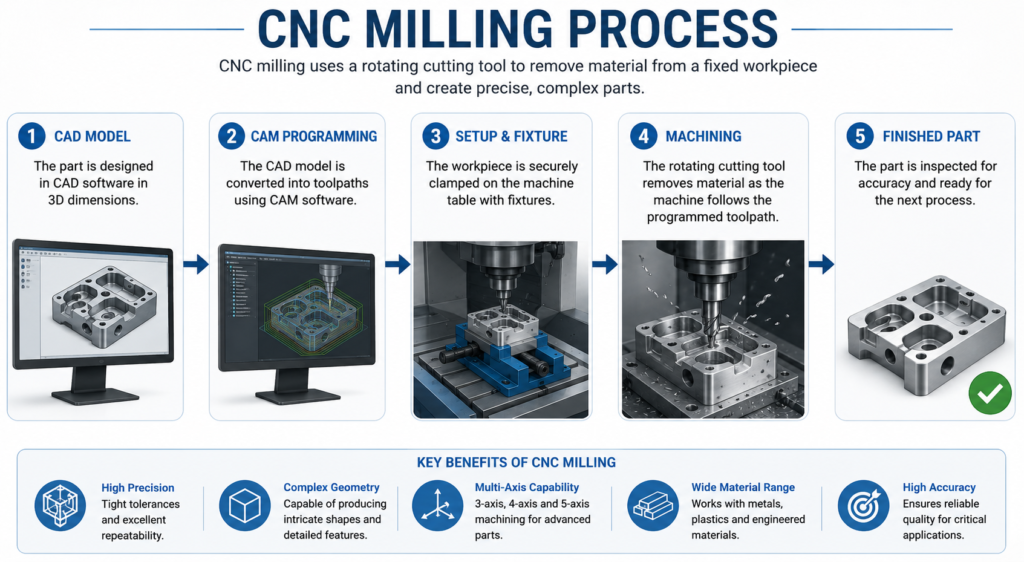
CNC Milling is a subtractive manufacturing process in which a rotating cutting tool removes material from a stationary workpiece to create the desired shape. The cutting tool moves along multiple axes—typically X, Y, and Z—to produce flat surfaces, pockets, slots, contours, drilled holes, and intricate three-dimensional geometries.
Modern CNC milling machines can operate on 3-axis, 4-axis, and 5-axis configurations, allowing manufacturers to produce highly complex parts with exceptional precision and repeatability.
Unlike manual milling, where machine movements depend on the operator’s skill, CNC milling relies on computer-generated G-code, ensuring every movement is accurate and repeatable.
Key Characteristics of CNC Milling
- The cutting tool rotates while the workpiece remains fixed.
- Suitable for machining flat, angular, and complex geometries.
- Capable of machining multiple faces of a component.
- Supports high-precision tolerances.
- Compatible with a wide range of metals and engineering plastics.
Common CNC Milling Operations
| Operation | Typical Application |
| Face Milling | Creating flat surfaces |
| End Milling | Slots, pockets, and contours |
| Profile Milling | External profiles and shapes |
| Drilling | Precision holes |
| Tapping | Internal threads |
| Pocket Milling | Cavities and recesses |
| Chamfer Milling | Edge finishing |
Typical Parts Manufactured Using CNC Milling
CNC milling is ideal for components with complex shapes and multiple machining features.
Examples include:
- Aerospace brackets
- Robot end-effectors
- Machine fixtures
- Heat sinks
- Mold inserts
- Valve bodies
- Electronic enclosures
- Medical equipment housings
- Automation components
- Precision tooling
These parts often require machining on several faces, making CNC milling the preferred manufacturing process.
Advantages of CNC Milling
CNC milling offers several advantages for precision manufacturing:
- Ability to produce complex geometries
- Excellent dimensional accuracy
- High repeatability
- Suitable for prototype and production machining
- Supports multi-axis machining for intricate designs
- Compatible with aluminum, stainless steel, titanium, brass, copper, and engineering plastics
However, because milling often involves multiple tool changes and setups, it can be more time-consuming and expensive than turning for simple cylindrical components.
What is CNC Turning?
While CNC milling uses a rotating cutting tool, CNC Turning works on the opposite principle.
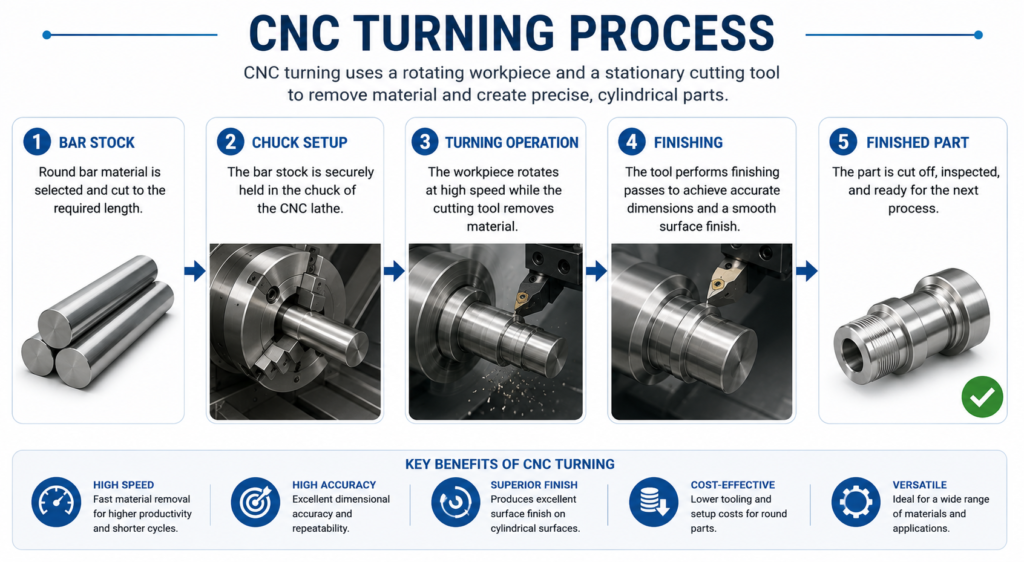
In CNC turning, the workpiece rotates at high speed, while a stationary cutting tool moves linearly along the rotating material to remove excess stock and produce the final shape.
This process is performed on a CNC lathe or CNC turning center, making it the preferred method for manufacturing cylindrical or rotationally symmetrical parts.
Common CNC Turning Operations
| Operation | Typical Application |
| Straight Turning | Reducing outer diameter |
| Facing | Creating flat end surfaces |
| Grooving | Retaining ring grooves |
| Thread Cutting | External/Internal threads |
| Parting | Separating finished parts |
| Boring | Enlarging internal diameters |
| Knurling | Grip patterns |
Typical Parts Produced by CNC Turning
Turning is best suited for parts with rotational symmetry.
Examples include:
- Shafts
- Bushings
- Pins
- Rollers
- Hydraulic pistons
- Sleeves
- Couplings
- Spacers
- Fasteners
- Valve stems
Since the workpiece rotates continuously, CNC turning is significantly faster than milling for these types of components.
Advantages of CNC Turning
- High production speed
- Excellent concentricity
- Superior surface finish on cylindrical features
- Lower machining cost for round parts
- Efficient material removal
- Highly repeatable production for large volumes
CNC Milling vs CNC Turning: Which Process is Right for Your Part?
CNC Milling vs CNC Turning: A Side-by-Side Comparison
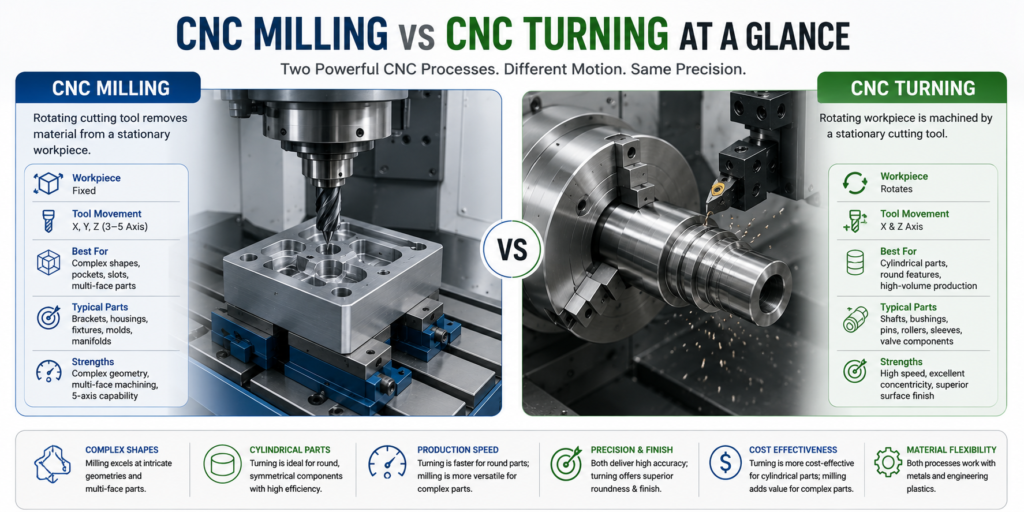
Now that we’ve explored how both machining processes work individually, let’s compare them across the parameters that matter most to design engineers, sourcing professionals, and procurement teams.
Although CNC Milling and CNC Turning are both precision manufacturing processes, they serve very different purposes. Choosing the correct process depends on your component geometry, functional requirements, material, tolerances, production volume, and budget.
CNC Milling vs CNC Turning Comparison Table
| Feature | CNC Milling | CNC Turning |
| Primary Motion | Rotating cutting tool | Rotating workpiece |
| Workpiece Position | Fixed | Rotates at high RPM |
| Best Suited For | Prismatic & complex parts | Cylindrical & symmetrical parts |
| Typical Components | Brackets, housings, fixtures | Shafts, bushes, rollers, pins |
| Machine Used | Vertical/Horizontal Machining Center | CNC Lathe / Turning Center |
| Tool Movement | X, Y, Z (3–5 Axis) | X & Z Axis |
| Complex Geometry | Excellent | Limited |
| Surface Finish | Excellent | Excellent on round surfaces |
| Dimensional Accuracy | Very High | Very High |
| Production Speed | Moderate | High |
| Material Removal Rate | Moderate | High |
| Programming Complexity | Higher | Lower |
| Cost for Round Parts | Higher | Lower |
| Cost for Complex Parts | More economical | Often requires secondary milling |
| Automation Potential | High | Very High |
Which Parts Are Best Suited for CNC Milling?
CNC Milling is the preferred manufacturing process whenever a component has multiple faces, intricate pockets, complex contours, or features that require machining from different angles.
Because the cutting tool can approach the workpiece from several directions, milling is ideal for producing parts with complex geometries that would be impossible or inefficient to manufacture using a lathe.
Common Components Manufactured Using CNC Milling
| Industry | Typical CNC Milled Parts |
| Aerospace | Structural brackets, wing fittings, avionics housings |
| Robotics | End effectors, robotic arms, base plates |
| Medical | Instrument housings, implant fixtures |
| Electronics | Heat sinks, enclosures |
| Industrial Automation | Fixtures, machine bases, manifolds |
| Semiconductor | Vacuum plates, precision mounts |
Modern 5-axis CNC milling machines can machine multiple faces in a single setup, significantly improving accuracy while reducing cycle time and handling errors.
When CNC Milling is the Right Choice
Choose CNC Milling if your component includes:
- Flat surfaces
- Slots
- Pockets
- Keyways
- Angled features
- Curved profiles
- 3D surfaces
- Multiple machined faces
- Complex cavities
- Precision drilled hole patterns
For engineers designing intricate components, CNC milling offers unmatched flexibility and geometric freedom.
Which Parts Are Best Suited for CNC Turning?
Unlike milling, CNC Turning is specifically designed for rotationally symmetrical parts.
The rotating workpiece allows material to be removed uniformly around its axis, producing components with excellent roundness, concentricity, and surface finish.
Common CNC Turned Components
| Industry | Typical CNC Turned Parts |
| Automotive | Shafts, pistons, hubs |
| Aerospace | Bushings, spacers, sleeves |
| Oil & Gas | Valve stems, couplings |
| Medical | Surgical pins, connectors |
| Robotics | Drive shafts, rollers |
| Industrial Equipment | Bearings, collars, spacers |
Turning is particularly efficient for high-volume production because machining cycles are generally shorter than comparable milling operations.
When CNC Turning is the Right Choice
Choose CNC Turning if your component is:
- Cylindrical
- Hollow
- Rotationally symmetrical
- Threaded
- Grooved
- Stepped
- Tapered
Components such as shafts, pins, rollers, and bushings can often be produced much faster and more economically on a CNC turning center.
Materials Compatible with Both Processes
One of the strengths of modern CNC machining services is their ability to machine a wide variety of engineering materials.
However, certain materials perform better in one process than the other depending on chip formation, rigidity, and machining strategy.
| Material | CNC Milling | CNC Turning | Typical Applications |
| Aluminum 6061 | ★★★★★ | ★★★★★ | Aerospace, Robotics |
| Aluminum 7075 | ★★★★★ | ★★★★★ | Aerospace Components |
| Stainless Steel 304 | ★★★★★ | ★★★★★ | Medical Equipment |
| Stainless Steel 316 | ★★★★★ | ★★★★★ | Food Processing |
| Mild Steel | ★★★★★ | ★★★★★ | Industrial Machinery |
| Brass | ★★★★★ | ★★★★★ | Electrical Components |
| Copper | ★★★★☆ | ★★★★★ | Conductive Parts |
| Titanium | ★★★★☆ | ★★★★☆ | Aerospace & Medical |
| Delrin (POM) | ★★★★★ | ★★★★★ | Automation Components |
| Nylon | ★★★★★ | ★★★★★ | Industrial Components |
A capable CNC machining manufacturer should be experienced in machining both metals and engineering plastics while recommending the optimal cutting parameters for each material.
Cost Comparison: CNC Milling vs CNC Turning
Cost is often one of the biggest considerations when selecting a machining process.
Although both methods are highly precise, they differ significantly in machining time, tooling requirements, programming complexity, and production efficiency.
| Cost Factor | CNC Milling | CNC Turning |
| Programming Time | Higher | Lower |
| Tooling Cost | Moderate | Lower |
| Machine Hour Rate | Higher | Moderate |
| Material Removal | Moderate | Faster |
| Cycle Time | Longer | Shorter |
| Setup Time | Higher | Lower |
| Production Cost | Better for complex parts | Better for round parts |
Key Takeaway
If your component is primarily cylindrical, CNC Turning is generally the most cost-effective option.
If your component contains multiple machined faces or complex features, CNC Milling usually provides better overall value despite a higher machine hour rate.
Tolerance Comparison
Both machining processes are capable of achieving excellent dimensional accuracy, provided the correct machine, tooling, and inspection methods are used.
| Feature | CNC Milling | CNC Turning |
| Standard Tolerance | ±0.05 mm | ±0.05 mm |
| Precision Machining | ±0.02 mm | ±0.01 mm |
| High-Precision Components | ±0.005 mm | ±0.005 mm |
| Surface Finish | Ra 1.6–0.8 µm | Ra 0.8–0.4 µm |
Turning often achieves superior concentricity and roundness because the workpiece rotates continuously during machining.
Milling, however, excels in maintaining positional accuracy across multiple faces and complex geometries.
Surface Finish Comparison
Surface finish is another important consideration, particularly for components used in aerospace, medical devices, precision engineering, and industrial automation.
CNC Milling
Produces excellent finishes on:
- Flat faces
- Pockets
- Contours
- Precision slots
- Complex 3D surfaces
CNC Turning
Produces exceptional finishes on:
- Cylindrical diameters
- Shafts
- Bores
- Tapers
- Threads
When appearance, friction, or sealing performance is critical, surface finish requirements should be specified clearly on engineering drawings.
Advantages of CNC Milling
✔ Machines highly complex geometries
✔ Produces intricate pockets and contours
✔ Supports 3-axis, 4-axis, and 5-axis machining
✔ Excellent for prototype development
✔ Suitable for multi-face machining
✔ Ideal for aerospace, robotics, and precision engineering components
Advantages of CNC Turning
✔ Faster machining cycles
✔ Lower manufacturing cost for cylindrical parts
✔ Superior concentricity
✔ Excellent surface finish
✔ Highly productive for volume manufacturing
✔ Reduced material waste
When Should You Choose CNC Milling?
Choosing the right machining process starts with understanding the geometry and functional requirements of your part. CNC Milling is the preferred choice when a component has complex shapes, multiple machined faces, pockets, slots, or intricate contours that cannot be produced efficiently on a lathe.
Since the cutting tool approaches the workpiece from different directions, CNC milling offers unmatched flexibility in creating detailed and highly engineered components.
Choose CNC Milling If Your Part Has:
- Multiple machined faces
- Complex 3D geometries
- Deep pockets and cavities
- Precision slots and keyways
- Irregular or non-cylindrical shapes
- Multiple drilled and tapped holes
- Angled features
- Complex contours
- Tight positional tolerances
- Components requiring 5-axis machining
Typical CNC Milled Components
| Industry | Examples |
| Aerospace | Structural brackets, avionics housings, wing fittings |
| Robotics | Robot arms, end-effectors, sensor mounts |
| Medical | Surgical equipment housings, fixtures |
| Industrial Automation | Machine bases, fixtures, manifolds |
| Electronics | Heat sinks, enclosures |
| Semiconductor | Precision plates, vacuum chambers |
When Should You Choose CNC Turning?
If your component is rotationally symmetrical, CNC Turning is almost always the most efficient manufacturing process.
Since the workpiece rotates while the cutting tool remains stationary, turning produces outstanding roundness, concentricity, and surface finish, often with significantly shorter cycle times than milling.
Choose CNC Turning If Your Part Is:
- Cylindrical
- Stepped
- Tapered
- Hollow
- Threaded
- Grooved
- Axially symmetrical
- High-volume production
Typical CNC Turned Components
| Industry | Examples |
| Automotive | Shafts, pistons, hubs |
| Aerospace | Bushings, spacers, sleeves |
| Oil & Gas | Valve stems, couplings |
| Medical | Bone screws, connectors |
| Industrial Machinery | Rollers, pins, bearing sleeves |
Can a Component Require Both CNC Milling and CNC Turning?
Absolutely.
Many precision-engineered components cannot be manufactured using only one machining process. In fact, aerospace, robotics, medical, semiconductor, and industrial automation industries frequently combine CNC Turning and CNC Milling to achieve the required geometry and functionality.
Consider a precision shaft with:
- Turned outer diameter
- Internal bore
- Cross-drilled holes
- Keyway
- Flat surfaces
- Threaded features
The shaft would first be produced on a CNC Turning Center to create its cylindrical profile. It would then move to a CNC Milling Machine to machine the flats, holes, keyways, and other non-rotational features.
Modern Turn-Mill Centers combine both machining processes into a single machine, eliminating multiple setups, improving accuracy, and reducing production time.
Industries That Use CNC Milling and CNC Turning
Both machining processes play an essential role in modern manufacturing. The choice depends on component design rather than industry alone.
| Industry | CNC Milling | CNC Turning |
| Aerospace | ✓ | ✓ |
| Robotics | ✓ | ✓ |
| Medical Devices | ✓ | ✓ |
| Industrial Automation | ✓ | ✓ |
| Electronics | ✓ | Limited |
| Semiconductor | ✓ | Limited |
| Oil & Gas | ✓ | ✓ |
| Automotive | ✓ | ✓ |
| Defense | ✓ | ✓ |
Many OEMs rely on manufacturing partners capable of performing both processes under one roof. This reduces logistics, shortens lead times, and ensures better dimensional consistency.
Common Mistakes When Selecting a Machining Process
Choosing the wrong machining process can increase production costs, extend lead times, and compromise part quality. Below are some of the most common mistakes engineers and procurement teams encounter.
1. Using CNC Milling for Simple Cylindrical Parts
While milling can produce round components, it is generally less efficient than turning for shafts, bushings, and pins.
2. Choosing CNC Turning for Complex Geometries
Turning is designed for rotationally symmetrical parts. Components with pockets, contours, and multiple machined faces typically require milling.
3. Ignoring Production Volume
A process suitable for prototypes may not be the most economical choice for large production runs. Manufacturing strategy should consider the entire product lifecycle.
4. Over-Specifying Tolerances
Unnecessarily tight tolerances increase machining time, tooling costs, and inspection requirements. Specify precision only where it impacts function.
5. Selecting a Supplier Based Only on Price
The lowest quotation may lead to hidden costs through poor quality, rework, delayed deliveries, and inconsistent production.
Frequently Asked Questions (FAQs)
Is CNC Milling more expensive than CNC Turning?
Generally, yes. CNC Milling often involves more complex programming, multiple cutting tools, longer machining cycles, and additional setups. However, for parts with intricate geometries, milling is the most efficient and cost-effective option.
Which process offers better accuracy?
Both CNC Milling and CNC Turning can achieve exceptional precision. Milling excels in maintaining positional accuracy across multiple faces, while turning delivers outstanding roundness and concentricity for cylindrical components.
Which process is faster?
For rotationally symmetrical components such as shafts, pins, and bushings, CNC Turning is usually faster due to continuous material removal. For complex prismatic parts, CNC Milling is the preferred choice despite longer cycle times.
Can aluminium be both milled and turned?
Yes. Aluminium alloys such as 6061, 6082, and 7075 are widely used in both CNC Milling and CNC Turning because of their excellent machinability, strength-to-weight ratio, and corrosion resistance.
Is 5-Axis CNC Milling always necessary?
No. While 5-axis machining offers significant advantages for complex aerospace and medical components, many parts can be manufactured more economically using 3-axis or 4-axis CNC milling. The optimal choice depends on the part geometry and production requirements.
Can one machine perform both milling and turning?
Yes. Modern Turn-Mill Centers integrate CNC Turning and CNC Milling into a single setup. These machines improve accuracy, reduce handling, and shorten overall production time, especially for complex components requiring multiple operations.
Final Thoughts
There is no universally superior machining process—only the process that best suits your component. CNC Milling excels at producing complex, multi-sided, and highly detailed parts, while CNC Turning is the ideal solution for cylindrical components requiring speed, concentricity, and cost efficiency.
For many precision-engineered products, the best solution is not choosing one process over the other but combining both. Understanding your component’s geometry, material, tolerances, and production volume allows you to select the most efficient manufacturing method, improving quality while reducing lead times and overall production costs.
Whether you’re developing a prototype or planning high-volume production, working with an experienced CNC machining manufacturer ensures that the right process is selected from the outset, helping avoid costly redesigns and manufacturing delays.
Why Choose HanaV for CNC Milling & CNC Turning?
At HanaV, we combine advanced CNC Milling and CNC Turning capabilities to manufacture precision components for customers across aerospace, robotics, industrial automation, medical devices, electronics, and general engineering. Our six ISO-certified manufacturing facilities are equipped with modern 3-axis, 4-axis, and 5-axis machining centers, high-performance CNC turning centers, and advanced inspection equipment to deliver consistent quality from prototype to production.
Beyond machining, we provide Design for Manufacturability (DFM) support, material selection guidance, secondary processes such as anodizing, plating, heat treatment, and integrated mechanical assemblies—all managed through a single point of contact. With a proven 99.23% on-time delivery and 99.41% first-time-right quality, HanaV helps customers reduce total manufacturing costs while maintaining the precision, reliability, and consistency required for mission-critical applications.