
Whether you’re designing an aerospace component, building a medical device, developing industrial automation equipment, or manufacturing parts for robotics, one manufacturing process consistently stands out for its precision, repeatability, and scalability – CNC Machining.
Computer Numerical Control (CNC) machining has transformed modern manufacturing by replacing manual machining with computer-controlled precision. Today, it enables manufacturers to produce components with micron-level accuracy, exceptional repeatability, and high productivity, making it one of the most trusted manufacturing methods worldwide.
However, successful CNC machining involves much more than loading raw material into a machine and pressing the Start button. Every high-quality machined component is the result of careful planning, proper material selection, accurate engineering drawings, GD&T requirements, achievable tolerances, the right machining strategy, and suitable equipment.
This guide explains the fundamentals of CNC machining while also exploring the engineering considerations that determine whether a part succeeds or fails during production.
1. What is CNC Machining?
CNC (Computer Numerical Control) Machining is a manufacturing process where computer-programmed machine tools remove material from a solid block, bar, or casting to create a finished component.
Unlike conventional machining, where an operator manually controls the machine, CNC machining follows a programmed set of instructions known as G-code. These instructions control every movement of the cutting tool with remarkable precision.
How CNC Machining Works
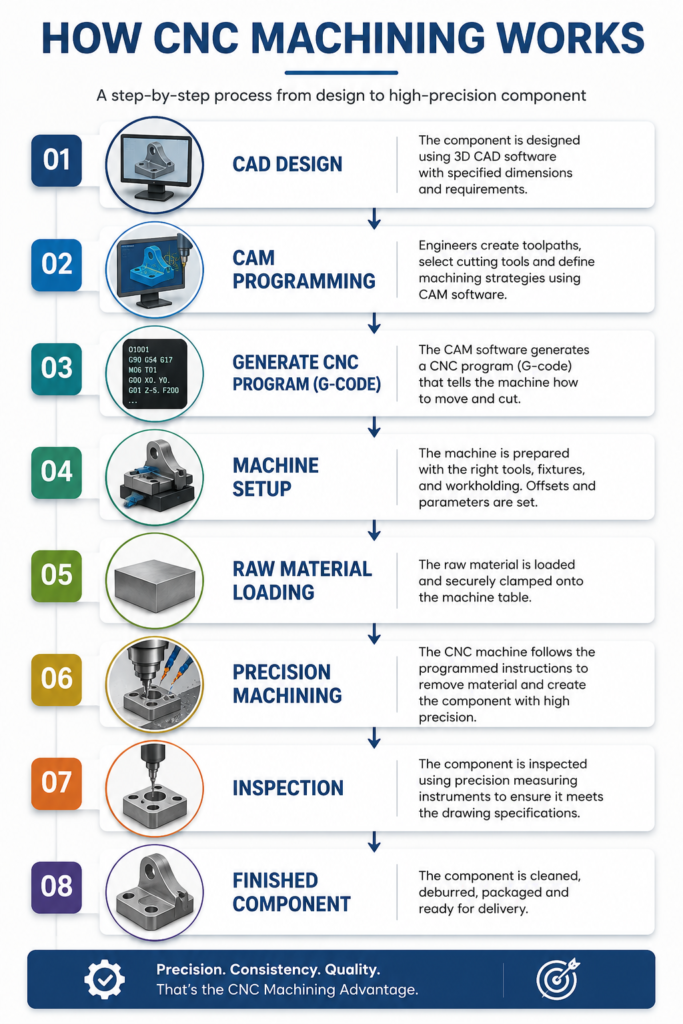
The process typically involves:
| Stage | Description |
| CAD Design | The component is designed using 3D CAD software. |
| CAM Programming | Toolpaths are created for machining. |
| CNC Programming | Machine-readable G-code is generated. |
| Setup | Material, fixtures, and cutting tools are prepared. |
| Machining | CNC machine removes material with high precision. |
| Inspection | Components are measured against engineering drawings. |
Common CNC Machining Processes
Different machining operations are used depending on the component geometry.
| Process | Purpose |
| CNC Milling | Produces flat surfaces, slots, pockets, contours, and complex geometries. |
| CNC Turning | Produces cylindrical parts such as shafts, bushings, and pins. |
| Drilling | Creates precision holes. |
| Tapping | Produces internal threads. |
| Boring | Improves hole accuracy and surface finish. |
| Reaming | Achieves highly accurate hole diameters. |
Advantages of CNC Machining
Modern manufacturers prefer CNC machining because it offers:
- Exceptional dimensional accuracy
- Excellent repeatability
- High production efficiency
- Ability to machine complex geometries
- Reduced human error
- Superior surface finishes
- Consistent quality from prototype to production
For industries where component reliability is critical, CNC machining provides a level of precision that manual methods cannot consistently achieve.
2. Understanding GD&T (Geometric Dimensioning & Tolerancing)
One of the most misunderstood areas in manufacturing is GD&T.
Many engineers assume dimensions alone define a component. In reality, dimensions specify size—but not how features relate to each other.
A component can meet every linear dimension on a drawing and still fail during assembly if its holes, surfaces, or axes are not correctly positioned.
This is where GD&T becomes essential.
What is GD&T?
Geometric Dimensioning and Tolerancing is a standardized engineering language used to define the allowable variation in the geometry of manufactured parts.
Instead of relying solely on ± tolerances, GD&T controls:
- Shape
- Orientation
- Position
- Runout
- Profile
- Concentricity
- Flatness
These controls ensure that every manufactured component functions as intended during assembly.
Why GD&T Matters
Imagine a mounting plate containing four bolt holes.
Every hole diameter may be perfectly machined.
However, if one hole shifts by just 0.15 mm, the bolts may no longer align, making assembly impossible.
GD&T prevents these issues by controlling feature locations relative to established datums.
Common GD&T Symbols
| Control | Purpose |
| Flatness | Ensures surfaces remain perfectly flat. |
| Parallelism | Maintains parallel surfaces. |
| Perpendicularity | Controls 90° relationships. |
| Position | Controls hole locations. |
| Circularity | Maintures roundness of cylindrical features. |
| Profile | Controls complex surfaces. |
| Runout | Controls rotating components. |
Benefits of GD&T
Proper GD&T helps manufacturers:
- Improve assembly accuracy
- Reduce scrap
- Improve interchangeability
- Simplify inspection
- Lower manufacturing costs
- Improve product reliability
Rather than making every dimension unnecessarily tight, GD&T allows designers to specify only what truly affects function.
3. Why Tolerances are Necessary
Every manufacturing process introduces slight variation.
No machining process can produce identical parts with absolute perfection.
Tolerances define how much variation is acceptable while ensuring the component still functions correctly.
Example
Suppose a shaft is designed to fit inside a bearing.
Nominal Diameter: 20.000 mm
Tolerance: ±0.010 mm
Acceptable Diameter:
19.990 mm – 20.010 mm
Any shaft outside this range may either:
- Fail to assemble
- Become loose
- Create excessive friction
- Reduce service life
Why Designers Should Avoid Overly Tight Tolerances
A common misconception is that tighter tolerances always produce better products.
In reality:
- They increase machining time
- Require specialized tooling
- Increase inspection effort
- Reduce production speed
- Raise manufacturing costs
Good engineering focuses on applying tight tolerances only where function demands them.
Typical CNC Machining Tolerances
| Feature | Typical Capability |
| General dimensions | ±0.05 mm |
| Precision machining | ±0.02 mm |
| Critical aerospace features | ±0.005–0.010 mm |
| Hole positioning | Application dependent |
The actual achievable tolerance depends on material, geometry, machine capability, tooling, and inspection methods.
4. Why Material Specifications are Critical
Selecting the correct material is just as important as selecting the correct machining process.
Even if two materials appear similar, their machining behavior, strength, corrosion resistance, and dimensional stability can differ significantly.
Why Material Specifications Matter
Engineering drawings often specify:
- Material grade
- Heat treatment
- Hardness
- Surface finish
- Coating
- Industry standards
These specifications ensure the finished component performs reliably in its intended application.
Example
Instead of specifying:
Stainless Steel
A drawing may specify:
- SS304
- SS316L
- 17-4 PH
- Duplex Stainless Steel
Each grade offers different mechanical properties and machining characteristics.
Factors Influencing Material Selection
| Factor | Importance |
| Strength | Load-bearing capability |
| Corrosion Resistance | Environmental durability |
| Weight | Aerospace & robotics applications |
| Thermal Stability | High-temperature applications |
| Wear Resistance | Long service life |
| Machinability | Manufacturing efficiency |
| Cost | Overall project economics |
Common CNC Machining Materials
| Material | Typical Applications |
| Aluminum | Aerospace, automation, electronics |
| Stainless Steel | Medical, food processing, marine |
| Mild Steel | Industrial equipment |
| Brass | Electrical components |
| Copper | Conductive parts |
| Titanium | Aerospace, medical implants |
| Engineering Plastics | Lightweight precision components |
Choosing the wrong material can result in premature wear, corrosion, machining difficulties, or unnecessary cost.
5. What Sort of Machines Should be Preferred?
Not every CNC machine is suitable for every component.
The best machine depends on geometry, tolerances, production volume, material, and complexity.
Common Types of CNC Machines
| Machine | Best For |
| 3-Axis VMC | General machining |
| 4-Axis CNC | Indexed machining |
| 5-Axis CNC | Complex aerospace and medical components |
| CNC Turning Center | Rotational components |
| Turn-Mill Center | Multi-operation parts |
| Swiss-Type CNC | Small precision parts |
When Should You Choose 5-Axis Machining?
5-axis machining becomes valuable when:
- Multiple angled features exist.
- Tight positional accuracy is required.
- Surface finish is critical.
- Fewer setups improve accuracy.
- Complex freeform geometries must be machined.
Although 5-axis machines involve higher investment, they often reduce overall manufacturing cost by minimizing setups and improving productivity.
Beyond Machines: The Importance of Manufacturing Capability
While machine selection is important, achieving consistent quality depends on much more than the equipment itself.
A capable machining partner should have:
- Experienced manufacturing engineers
- Robust CAM programming
- Process planning expertise
- Modern cutting tools
- Preventive machine maintenance
- In-process inspection
- Coordinate Measuring Machines (CMM)
- Documented quality systems
- Traceable manufacturing records
Even the most advanced CNC machine cannot compensate for poor process control or inadequate quality assurance.
Industries That Depend on CNC Machining
CNC machining plays a vital role across numerous industries where precision and reliability are non-negotiable.
| Industry | Typical Components |
| Aerospace | Structural brackets, housings, flight-critical components |
| Medical | Surgical instruments, implants, diagnostic equipment |
| Robotics | End effectors, joints, precision frames |
| Industrial Automation | Machine parts, fixtures, tooling |
| Semiconductor | Precision plates, vacuum components |
| Electronics | Heat sinks, enclosures, connectors |
| Automotive | Transmission parts, prototypes, engine components |
Final Thoughts
CNC machining is far more than a manufacturing process—it is the foundation of modern precision engineering. Producing high-quality components consistently requires the right combination of design intent, GD&T, realistic tolerances, correct material specifications, capable machinery, and disciplined manufacturing processes.
For engineers and procurement professionals alike, understanding these fundamentals leads to better design decisions, fewer production issues, improved product performance, and lower total manufacturing costs. As products become more sophisticated and quality expectations continue to rise, partnering with a manufacturer that combines technical expertise with robust quality systems becomes increasingly important.
How HanaV Can Help
At HanaV, we specialize in delivering precision CNC machining solutions for customers across industries including aerospace, industrial automation, robotics, medical devices, electronics, and general engineering. Our ISO-certified manufacturing facilities are equipped with advanced CNC milling and turning centers, supported by rigorous quality control processes and experienced manufacturing engineers. Whether you require prototypes, low-volume production, or high-volume manufacturing, we focus on delivering cost-effective solutions without compromising on quality, consistency, or on-time delivery. By combining engineering expertise with efficient production practices, HanaV helps customers reduce manufacturing costs while ensuring every component meets demanding performance and quality expectations.